
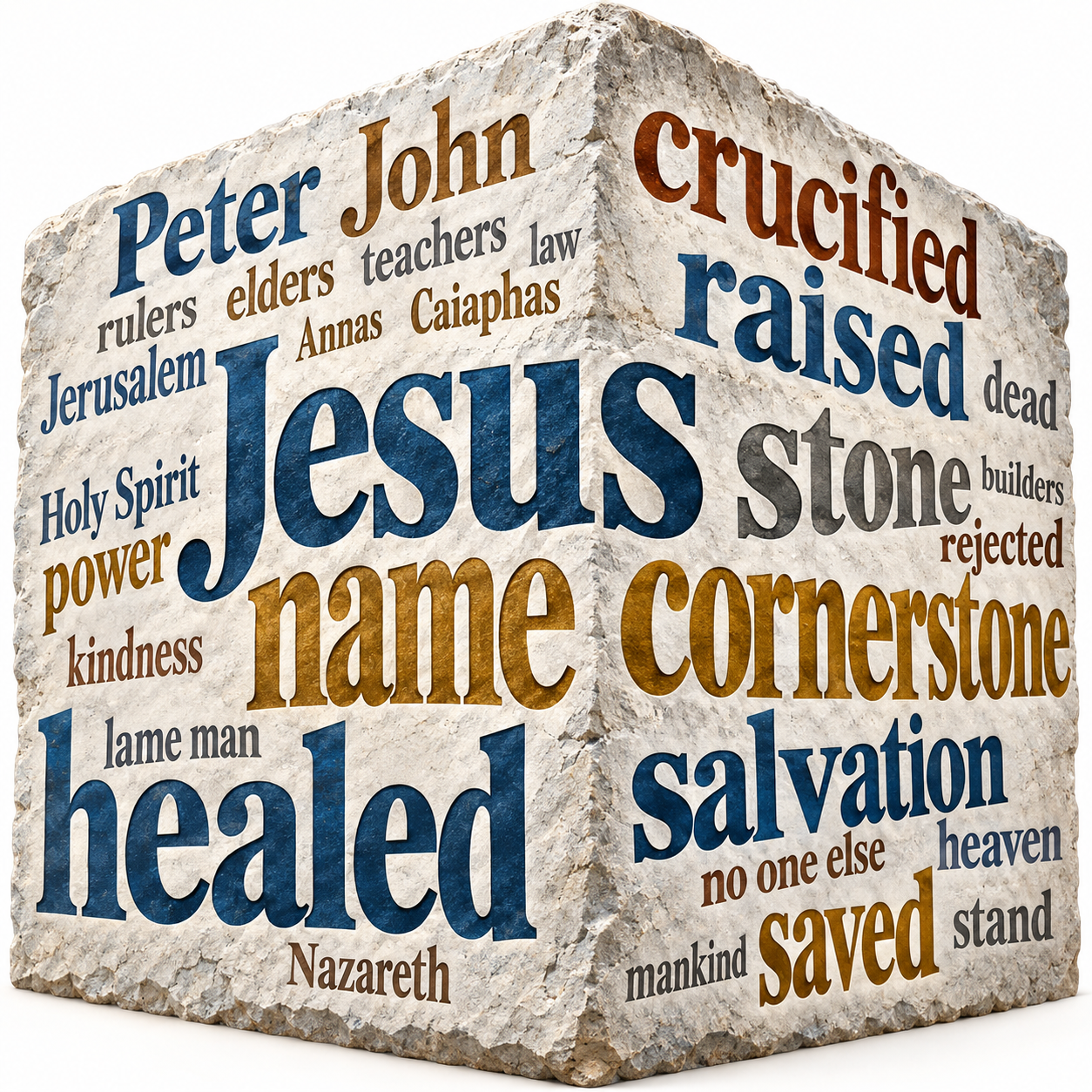
Acts 4:5–12 places Peter and John in a situation that should have frightened them. Only a short time earlier, Jesus had stood before some of these same religious authorities. Peter had been nearby then, but he had been so afraid that he denied even knowing Jesus. Now Peter stands openly before Jerusalem’s leaders and speaks the very name he once tried to distance himself from.
The change in Peter is impossible to miss. He has not simply become more confident. Pentecost has happened. Peter has witnessed the risen Christ, received the Holy Spirit, and begun to understand that the resurrection has changed everything. When the authorities ask who gave Peter and John the right to do what they have done, Peter does not soften his answer. The man who had been unable to walk has been healed through Jesus Christ of Nazareth, the One who was crucified and whom God raised from the dead.
Peter then makes one of the clearest statements about Jesus found anywhere in the New Testament: “Salvation is found in no one else.” That statement is sometimes treated as though Peter is trying to win a religious argument, but that is not the setting. Peter is not the powerful person in the room. He is a prisoner being questioned by men who have authority over him. He is not claiming that he and John are better than anyone else. In fact, Peter has already refused to take credit for the healing. He is saying the opposite. The power does not belong to Peter. Salvation does not come from Peter. It comes from Jesus.
This passage brings several themes together. It is about Christian courage, the work of the Holy Spirit, the resurrection, the identity of Jesus, the relationship between compassionate ministry and gospel witness, and the meaning of salvation. It also forces Christians to think carefully about how we speak of Christ in a world filled with people who believe differently from us.
Peter is clear that salvation comes through Christ alone. But Christian certainty about Jesus should never become certainty about our own superiority. We stand beside the healed man in this story, not above him. We are people who have received something we could never produce for ourselves. Grace comes first, and because salvation is grace, the name of Jesus should be spoken with both courage and humility.
Origin and Name
The
book we call Acts is the second part of a two-volume work that begins with the
Gospel of Luke. Acts 1:1 refers back to the author’s “former book,” which told
what Jesus “began to do and to teach.” That wording is important because it
suggests that the work of Jesus did not end with His ascension. Luke’s Gospel
records the earthly ministry of Jesus, while Acts shows that His work continues
through the Holy Spirit and through the people who become His witnesses.
The
traditional title, The Acts of the Apostles, was probably added after
the work itself was written. The title is useful, but it does not describe the
book perfectly. Acts does not attempt to record everything done by all the
apostles. Peter receives considerable attention in the opening chapters, and
Paul dominates much of the second half of the book, while several apostles
receive little individual attention. The real subject is broader. Acts tells
how the risen Christ continues His mission through the Holy Spirit as the
gospel moves from Jerusalem toward the wider world (Bruce).
Authorship
Acts and the Gospel of Luke clearly come from the same author. They share vocabulary, theological themes, literary style, and an address to the same recipient, Theophilus. Acts 1:1 directly refers to the Gospel as the author’s earlier volume.
Early Christian tradition identifies the author as Luke, the physician and companion of Paul mentioned in Colossians 4:14, Philemon 24, and 2 Timothy 4:11. Modern scholars differ on how confidently that traditional identification can be established from the text itself, but there is broad agreement that Luke and Acts form a unified two-volume work (Johnson; Keener).
The author shows special interest in prayer, the Holy Spirit, people living on the margins of society, women, the poor, healing, table fellowship, Gentile inclusion, and the movement of God’s grace across boundaries that people often try to maintain. Those themes begin in Luke’s Gospel and continue throughout Acts.
Date and Setting
The precise date of Acts remains debated. Some scholars argue for a date in the early 60s, while many place the completed work after the destruction of Jerusalem in AD 70, often somewhere between AD 70 and 90 (Johnson; Barrett). The events described in Acts 4, however, occur much earlier, during the first years of the Christian movement.
Jerusalem remains the center of the story. The followers of Jesus have not yet become a separate religion in the way Christianity and Judaism would later develop. Peter and John are Jews. The man who is healed is Jewish. The crowd is largely Jewish. The rulers questioning them are Jewish religious leaders. This matters because Acts 4 must never be treated as a story about Christians standing against “the Jews” as though the two groups were already completely separate. The conflict is an internal first-century Jewish dispute concerning Jesus of Nazareth, His resurrection, and the authority of His followers.
Purpose and Themes
Acts describes the spread of the gospel through the power of the Holy Spirit. Jesus gives the basic movement of the book in Acts 1:8 when He tells the disciples that they will receive power when the Holy Spirit comes upon them and will become His witnesses in Jerusalem, Judea, Samaria, and to the ends of the earth. That movement shapes the entire book.
Major themes include the resurrection of Jesus, the Holy Spirit, witness, mission, prayer, salvation, repentance, forgiveness, healing, opposition, Christian community, generosity, and the growing inclusion of Gentiles. Acts repeatedly shows that the Church advances through God’s power rather than human strength. The believers are often vulnerable. They face arrests, threats, imprisonment, opposition, disagreement, persecution, and sometimes death. Yet the gospel continues moving outward. Acts therefore presents the Church at its strongest when it depends most completely upon God.
Structure
Acts 1:8 provides a useful framework for understanding the book. Acts 1–7 focuses primarily on the witness of the Church in Jerusalem. Acts 8–12 shows the gospel moving into Judea, Samaria, and beyond traditional Jewish boundaries. Acts 13–28 follows the expanding Gentile mission, particularly through Paul, until the story reaches Rome.
Acts 4:5–12 belongs to the Jerusalem section. The Church is still very young. Pentecost has recently taken place. Thousands have responded to the gospel. The apostles continue teaching, praying, sharing possessions, worshiping, and performing signs among the people. But growth is quickly accompanied by opposition. Acts 4 records the first direct attempt by authorities to silence the apostles.
Significance
Acts is important because it shows what resurrection faith looks like when it becomes public. The disciples do not simply believe privately that Jesus is alive. His resurrection changes how they speak, serve, pray, share resources, face opposition, cross social boundaries, and understand the mission of God.
Acts also shows that the Holy Spirit does not create a flawless Church. The Christian community still struggles with dishonesty, prejudice, disagreement, cultural differences, and leadership challenges. Yet God continues to work through imperfect people. This becomes especially clear in Peter. The man standing before the Sanhedrin in Acts 4 is the same man who denied Jesus in Luke 22. His previous failure has not disqualified him from future faithfulness. Grace has done something with Peter’s failure, and that is one of the quiet but powerful messages running underneath this passage.
Acts 4:5–12 cannot be understood apart from what happens in Acts 3. Peter and John are going to the temple at the time of prayer when they encounter a man who has been unable to walk from birth. He is carried daily to the temple gate so that he can ask people for money. Peter tells him that he does not have silver or gold, but he offers what he does have. In the name of Jesus Christ of Nazareth, Peter tells the man to walk. Peter takes him by the hand, the man’s feet and ankles become strong, and he enters the temple walking, jumping, and praising God.
The miracle draws a crowd, but Peter immediately refuses to accept credit. He asks why people are staring at him and John “as if by our own power or godliness we had made this man walk” (Acts 3:12). That sentence prepares us for Acts 4. Peter does not believe that he possesses special power. Jesus is the source of the healing.
Peter then preaches about Jesus, His death, His resurrection, repentance, and the fulfillment of God’s promises. That preaching attracts the attention of the religious authorities. Acts 4:1 explains that the priests, captain of the temple guard, and Sadducees are disturbed because Peter and John are teaching the people and proclaiming “in Jesus the resurrection of the dead.” The reference to resurrection is especially important because the Sadducees rejected belief in resurrection. Peter and John are therefore challenging both their theology and their authority.
The apostles are arrested and held overnight. The following morning they are brought before Jerusalem’s rulers, elders, and teachers of the law. The scene deliberately reminds us of Jesus’ own trial. Luke names Annas and Caiaphas, both of whom appeared in the story surrounding Jesus’ arrest and crucifixion. Peter now stands before people connected with the same leadership establishment that condemned Jesus.
Yet Peter is different now. The servant girl’s question once caused him to deny Christ. The Sanhedrin’s question now gives him an opportunity to proclaim Christ. The difference is not that Peter has suddenly developed a stronger personality. Acts 4:8 tells us the difference. Peter is “filled with the Holy Spirit.”
The passage also reaches backward into the Old Testament. Peter quotes Psalm 118:22: “The stone the builders rejected has become the cornerstone.” Jesus Himself had used this passage in Luke 20:17 after telling the parable of the wicked tenants. Peter now applies the same Scripture directly to Jesus. The One rejected by human leaders has been chosen and vindicated by God. The cross looked like rejection, but the resurrection revealed God’s verdict.
Acts 4:5–12 fits naturally within Wesleyan theology because the entire passage begins with what God has done rather than what human beings accomplish. Peter does not heal the man through personal ability. Peter does not raise Jesus from the dead. Peter does not generate the courage needed to confront the council. God acts first.
This pattern reflects the Wesleyan understanding of grace. John Wesley taught that God’s grace is already at work before we become aware of it. Prevenient grace awakens, convicts, draws, and enables human beings to respond to God. Grace does not eliminate human freedom. It makes genuine response possible.
Randy Maddox describes Wesley’s theology as “responsible grace,” emphasizing the relationship between God’s gracious initiative and meaningful human participation. God reaches toward us, but God does not force love, faith, or obedience upon us (Maddox). We see that same pattern throughout Acts. The Spirit empowers Peter, but Peter must speak. The gospel is proclaimed, but the hearers must respond. God offers grace, but people may receive or resist it.
Acts 4 also connects with the Wesleyan understanding of salvation as something larger than simply being forgiven. Verse 9 asks how the man was “healed.” Luke uses a form of the Greek verb sōzō, a word that can mean to save, rescue, deliver, or heal depending on the setting. The same family of words appears again when Peter speaks about salvation in verse 12 (Barrett; Marshall).
Luke is not claiming that physical healing and eternal salvation are identical. The healed man will still someday die. But his restoration becomes a sign of something larger. God’s salvation moves toward wholeness. Wesley understood salvation as pardon from sin, deliverance from its power, new birth, growth in holiness, restoration of relationship with God, and the gradual renewal of God’s image within the believer. Grace does not simply change our destination after death. Grace begins changing us now.
Acts 4:12 also fits Wesley’s conviction that salvation rests entirely in Jesus Christ. At the same time, Wesley strongly emphasized the universal reach of God’s grace. Christ’s saving work is sufficient for all people. Prevenient grace reaches every human life. No person begins beyond the reach of God’s love.
That gives us an important way of hearing Peter’s declaration. The statement “salvation is found in no one else” does not mean God loves only Christians. It means Jesus is the source of salvation God offers to the world. The exclusiveness is about the Savior, not the reach of divine love. God’s love is wider than we imagine, and Christ is the One through whom that saving love is given.
Acts 4:5–6: The Powerful Gather
Luke tells us that the next day “the rulers, the elders and the teachers of the law” assemble in Jerusalem. These groups represent the religious leadership associated with the Sanhedrin, the governing council responsible for many religious and community matters.
Luke specifically names Annas, Caiaphas, John, Alexander, and other members of the high priest’s family. Annas had officially served as high priest earlier but remained extremely influential. Several members of his family eventually held the office. Caiaphas, his son-in-law, served as high priest during the period when Jesus was crucified (Bruce).
For Luke’s readers, these names would sound familiar. Peter is standing before people associated with the condemnation of Jesus. The setting alone creates tension. The question is not simply whether Peter can explain a healing. He must decide whether he will identify himself openly with the Jesus these leaders rejected.
Acts 4:7: “By What Power or What Name?”
Peter and John are placed in the center of the council, and the leaders ask, “By what power or what name did you do this?” The question is about authority. In the biblical world, a name was more than a label. It represented identity, character, reputation, and authority.
The council wants to know whose authority Peter and John claim. That question becomes especially important because Peter healed the man “in the name of Jesus Christ of Nazareth.” The apostles are not treating Jesus’ name like a magical formula. Peter has already said the power is not his own. Acting in Jesus’ name means acting under the authority of the risen Lord.
There is also some irony in the question. The leaders are trying to investigate Peter. Instead, they give him an opportunity to preach. Sometimes the questions Christians fear most become openings for witness.
Acts 4:8: “Filled With the Holy Spirit”
Luke does not allow us to explain Peter’s courage simply by saying Peter has changed his attitude. Before Peter answers, Luke tells us that he is “filled with the Holy Spirit.” That phrase connects this moment with Pentecost and with Jesus’ earlier promise.
In Luke 12:11–12 Jesus tells His disciples that when they are brought before synagogues, rulers, and authorities, they should not become anxious about what to say because the Holy Spirit will teach them. Acts 4 is a fulfillment of that promise. Peter is doing exactly what Jesus said His followers would one day do.
This helps us understand what Spirit-filled courage looks like. Peter does not become reckless. He does not insult the council. He does not threaten anyone. He speaks clearly about Jesus. The Spirit does not produce arrogance. The Spirit produces faithful witness.
Acts 4:9: “An Act of Kindness”
Peter begins by pointing out something strange about the situation. He and John are being questioned because of “an act of kindness shown to a man who was lame.” A man has been helped, yet the people involved in helping him are standing before a tribunal.
Peter’s language exposes the tension without becoming disrespectful. The Greek word translated “act of kindness” refers to a good deed or beneficial act. Then Peter asks how the man was “healed.” The word Luke uses comes from sōzō, which can carry the meanings of saving, rescuing, healing, or making whole.
That word choice prepares the reader for verse 12. The man’s physical restoration becomes a visible sign of the greater salvation Peter is about to proclaim. The gospel is concerned with whole people. Jesus cares about bodies. He cares about suffering. He cares about sin. He cares about broken relationships. He cares about eternal life.
Christian ministry should never force a choice between caring for human needs and speaking about salvation. Acts brings the two together.
Acts 4:10: Jesus Christ of Nazareth
Peter answers the council’s question directly. The man has been healed “by the name of Jesus Christ of Nazareth.” Peter does not hide behind vague religious language. He names Jesus.
Then he says something even more confrontational. Jesus is the One “whom you crucified but whom God raised from the dead.” Luke creates a sharp contrast. Human authorities rejected Jesus, but God raised Him. The resurrection becomes God’s vindication of the One who had been condemned.
This verse must be handled carefully. Peter is speaking to particular leaders within a particular historical setting. His words must never be expanded into collective blame against Jewish people. Jesus Himself was Jewish. Peter was Jewish. John was Jewish. The healed man was Jewish. The earliest Christians were Jewish. Crucifixion was also a Roman method of execution carried out under Roman political authority.
The New Testament ultimately understands the cross within the larger reality of human sin, not as a basis for hatred against an ethnic or religious group. The Church has a tragic history of using passages connected with Jesus’ crucifixion to encourage antisemitism. That use of Scripture is incompatible with the gospel being proclaimed here.
Peter’s point is not ethnic blame. His point is resurrection. Human rejection was not the final word about Jesus. God had the final word.
Acts 4:10: “This Man Stands Before You Healed”
Peter does not offer the council an abstract theological argument alone. The evidence is standing in front of them. The man who had been unable to walk now stands before the council healed.
Luke returns to this fact again in verse 14 when he says the leaders could see the healed man standing with Peter and John and therefore had nothing to say. That detail is important because Christian testimony should have visible consequences.
That does not mean every Christian will experience miraculous physical healing. Acts itself contains suffering that does not disappear. Stephen will be killed. James will be executed. Paul will experience beatings, imprisonment, hardship, and eventually death. The healing of the man is a sign of the kingdom, not a promise that every faithful believer will receive immediate physical healing.
But wherever the gospel takes root, something should become visible. Lives change. People forgive. The lonely are welcomed. The hungry are fed. The broken receive care. Enemies become neighbors. Fear begins giving way to hope. The Church cannot manufacture those things perfectly, but our witness should leave some evidence that the risen Christ is alive among us.
Acts 4:11: The Rejected Stone
Peter quotes Psalm 118:22 and says that “the stone you builders rejected” has become the cornerstone. The image is striking because Peter refers to the religious leaders as builders. Builders are expected to recognize good stone, yet these leaders rejected the very stone God selected.
The verse warns us that religious authority does not guarantee spiritual perception. People can know Scripture and still misunderstand what God is doing. People can hold respected positions and still resist grace. People can be convinced they are protecting God’s work while actually standing against it. That warning belongs to every generation of the Church.
The verse also carries tremendous hope. Jesus was rejected. He was mocked. He was crucified. Yet rejection did not cancel God’s purpose. The stone people discarded became the cornerstone of God’s saving work. What human beings dismissed, God chose.
Acts 4:12: “Salvation Is Found in No One Else”
Peter now moves from one healed man to the salvation of humanity. “Salvation is found in no one else.” The statement is intentionally clear. Peter does not present Jesus as one helpful religious teacher among many. He identifies Jesus as God’s unique means of salvation.
The next phrase widens the scope further: “there is no other name under heaven given to mankind by which we must be saved.” The words “under heaven” give the statement universal reach. Peter is not describing a Savior for one nation or one culture.
Acts will spend the rest of the book showing the gospel crossing boundaries. It will move toward Samaritans. It will reach an Ethiopian official. It will enter the home of Cornelius, a Roman centurion. It will move into Gentile cities across the Mediterranean world. Eventually Paul will preach in Rome itself.
The salvation found in Jesus is particular in its source and universal in its invitation.
The word “given” also matters. Salvation is gift. We do not invent it. We do not earn it. We do not achieve it through religious performance. God gives what humanity cannot provide for itself.
That truth should shape the tone in which Christians speak about Acts 4:12. Peter is not boasting about Christians. Christianity did not save anyone. A denomination does not save anyone. A church building does not save anyone. A pastor does not save anyone. Jesus saves. That leaves no room for superiority.
Acts 4:12 is one of the verses most likely to create discomfort in a religiously pluralistic society because Peter makes an exclusive truth claim. He says salvation is found in Jesus and nowhere else. But making a truth claim is not the same thing as treating people badly. Christians can believe that Jesus is the unique Savior while respecting the dignity and religious freedom of people who disagree.
In fact, the New Testament gives the Church no authority to coerce faith. Jesus invites. The apostles proclaim. The Spirit convicts. People respond freely. Some believe, while others refuse. Christian mission should follow that same pattern. We can speak clearly without becoming cruel. We can disagree without dehumanizing. We can confess Jesus as Lord while loving neighbors who do not share that confession. If salvation truly comes through Jesus, then our manner of witness should resemble Jesus.
Acts 4:12 also does not mean that God loves only Christians. The claim that salvation comes through Christ is not a claim that God’s love is limited to those who already believe. The New Testament repeatedly presents God’s saving purpose as flowing from love for the world. John 3:16 begins with God loving the world, and Romans 5:8 describes Christ dying for sinners before they had made themselves worthy.
Wesleyan theology adds the language of prevenient grace to explain that God is already reaching toward every person before that person consciously responds. Christ is the source of salvation precisely because God loves a fallen world. The uniqueness of Christ and the wideness of God’s love should not be placed against each other. They belong together.
Acts 4:12 identifies the source of salvation, but it does not provide a detailed explanation of how God judges every person who has lived without a clear opportunity to hear the gospel. Christians should be careful not to make the verse answer questions Peter is not addressing. Wesleyan theology allows us to affirm that all salvation comes through Jesus Christ while also affirming that God’s prevenient grace is at work in every human life.
God knows every person completely. God is perfectly just. God is perfectly loving. We can trust God with questions Scripture does not answer fully. At the same time, Acts gives the Church no reason for indifference. If Christ is Savior, His people are called to make Him known.
The passage also helps us understand what it means to act in Jesus’ name. Peter is not using Jesus’ name as a formula for spiritual power. He acts in Jesus’ name because he belongs to Jesus and serves under His authority. Later in Acts 19, the sons of Sceva attempt to use Jesus’ name as though it were a spiritual technique, and the result shows that the name cannot be separated from relationship with and submission to Christ.
Praying or ministering “in Jesus’ name” is therefore not about saying the correct words. It means acting under His lordship and seeking to reflect His character.
The first application of this passage is that the Church must keep Jesus at the center. The cornerstone determines the shape and stability of the building, and that image gives the Church a necessary question: What are we actually building around? Churches can slowly organize themselves around personalities, traditions, buildings, programs, attendance numbers, finances, political concerns, denominational identity, or fear about the future. Some of those things have legitimate places, but none of them can be the cornerstone. Jesus must remain the center. When Christ moves to the edge, even successful ministry can lose its purpose.
Acts 3 and 4 also refuse to separate compassion from witness. Peter and John help a suffering man, and then they talk about Jesus. They do not help him merely as a strategy to gain a convert. The man matters because he is a person loved by God. But neither do they pretend their compassion has nothing to do with Christ.
The same balance matters today. The Church feeds people because hungry people matter. We visit prisoners because prisoners matter. We care for grieving families because they matter. We help neighbors after storms because they matter. We welcome strangers because they matter. And when someone asks why grace moves us toward people, we should not be afraid to name Jesus.
This passage also reminds us that we do not need Peter’s personality to have Peter’s courage. Some Christians read this story and immediately think they could never speak like Peter. But Acts does not tell us to imitate Peter’s personality. It tells us to depend upon Peter’s God.
The same man who once denied Jesus now speaks boldly because he is filled with the Spirit. The Church does not need everyone to become naturally outgoing or confrontational. Faithful witness takes many forms. Sometimes courage means speaking publicly. Sometimes it means quietly telling a friend why you still trust God. Sometimes it means praying with someone who is afraid. Sometimes it means defending someone who is being mistreated. Sometimes it means admitting that you were wrong. Sometimes it means refusing to remain silent when silence would protect injustice. The Holy Spirit gives different people the courage needed for the moment in front of them.
Acts 4:12 should also make Christians humble. If salvation is found in Jesus rather than in us, Christians have no reason to act superior. We did not save ourselves. We did not defeat death. We did not earn grace. We did not create the cross. We received.
That truth should affect the way we speak to people who believe differently. Clear conviction and genuine humility can live together. In fact, they should. The more certain we become that salvation is grace, the less reason we have to boast.
The image of the rejected stone also reminds us that human rejection does not determine God’s purpose. The builders rejected the stone, but God made it the cornerstone. That does not mean every rejection we experience will eventually be reversed in the way we hope. Some doors remain closed. Some relationships remain broken. Some opportunities do not return.
But Acts 4 reminds us that human judgment is never the final measure of what God can do. The cross looked final. It was not. The tomb looked final. It was not. The authorities thought they could silence the name of Jesus. They could not. Resurrection faith teaches us not to confuse what appears finished with what God may still be doing.
Finally, the name we speak should be visible in the lives we live. Peter proclaims Jesus while a healed man stands beside him, and that image is worth remembering. Our witness becomes more believable when people can see evidence of Christ’s grace among us.
If we preach forgiveness, people should find forgiveness. If we preach grace, people should encounter grace. If we preach the love of Christ, lonely and rejected people should find room among us. If we proclaim a Savior who restores human dignity, our churches should treat people with dignity.
We will never live that witness perfectly. But the name on our lips should increasingly become visible in the life we share.
Psalm 118:22–23 provides the Old Testament background for Peter’s declaration that the rejected stone has become the cornerstone. Isaiah 28:16 also speaks of God laying a tested and precious cornerstone in Zion. Jesus Himself uses the rejected-stone imagery in Luke 20:9–19, connecting Psalm 118 with His coming rejection.
Luke 12:11–12 records Jesus promising that the Holy Spirit would teach His followers what to say when they were brought before rulers and authorities. Luke 22:54–62 records Peter’s denial of Jesus and provides the striking contrast with his courage in Acts 4.
Acts 1:8 establishes Spirit-empowered witness as one of the central themes of the book. Acts 2:22–36 records Peter proclaiming the death, resurrection, and lordship of Jesus at Pentecost, while Acts 3:1–26 gives the healing and preaching that lead directly into the events of Acts 4. Acts 4:13–22 continues the hearing and shows the authorities astonished by Peter and John’s courage, and Acts 4:23–31 records the Church praying for boldness and being filled again with the Holy Spirit.
John 3:16–17 connects God’s saving action in Christ with God’s love for the world, while John 14:6 records Jesus identifying Himself as the way, the truth, and the life. Romans 5:6–8 emphasizes that Christ’s saving work begins in grace toward sinners rather than human worthiness, and Romans 10:9–13 connects salvation with confessing Jesus as Lord and trusting in His resurrection.
First Corinthians 3:11 declares that no foundation can be laid other than Jesus Christ. Ephesians 2:19–22 pictures God’s people as a household with Christ Jesus Himself as the cornerstone. Philippians 2:9–11 describes God exalting Jesus and giving Him the name above every name, while 1 Peter 2:4–8 develops the rejected-stone imagery and identifies Jesus as rejected by human beings but chosen and precious to God.
