
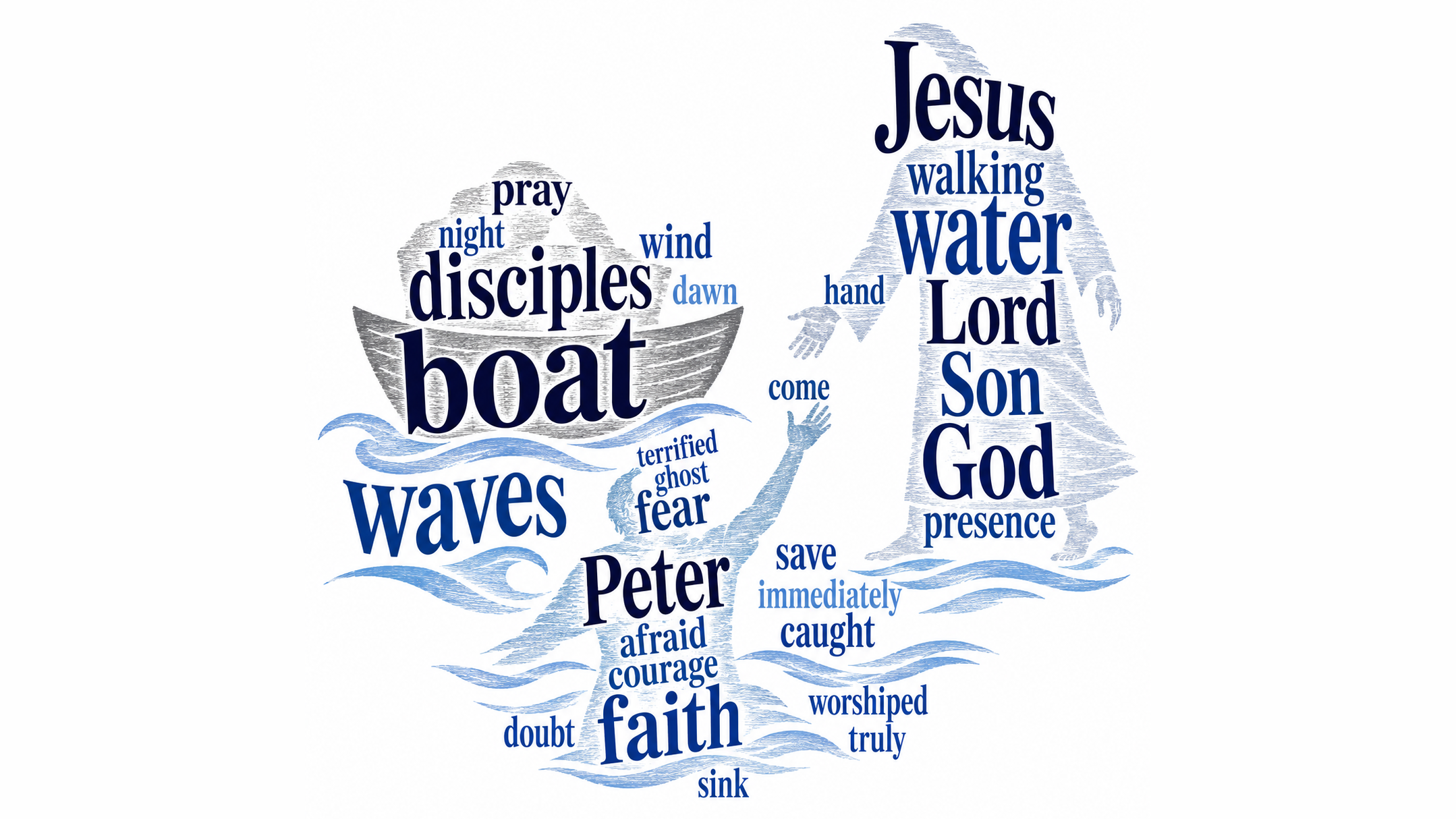
Matthew 14:22–33 speaks to the fear that rises when we’re far from shore and the wind turns against us. The disciples are exactly where Jesus told them to be, yet obedience doesn’t protect them from the storm. Their struggle reminds us that hardship isn’t always evidence that we’ve wandered outside God’s will. Sometimes storms meet us while we’re faithfully doing what Christ asked us to do.
Jesus has just fed more than five thousand people with five loaves and two fish. The crowd has eaten, the disciples have gathered the leftovers, and what began as scarcity has become abundance. Yet Jesus doesn’t allow the disciples to remain in that moment of success. He sends them across the lake while He dismisses the crowd and withdraws to pray.
During the night, the disciples’ boat is battered by waves. They’re tired, frightened, and unable to make progress. Jesus comes to them by walking on the water. At first, they don’t recognize Him. Fear distorts their vision, and the One coming to help them appears to be another threat.
Jesus answers their fear with three commands: “Take courage! It is I. Don’t be afraid.” His words don’t begin with an explanation of the storm. They begin with the assurance of His presence. The wind is still blowing, but Jesus is near.
Peter asks to come to Jesus on the water. He steps out of the boat and walks toward Him, but when his attention shifts from Jesus to the wind, he begins to sink. His prayer becomes only three words: “Lord, save me!” Jesus immediately reaches out and catches him. Peter’s faltering faith doesn’t place him beyond Christ’s reach. Grace catches him before correction comes.
When Jesus enters the boat, the wind stops. The disciples worship Him and confess, “Truly you are the Son of God.” The storm becomes a place of revelation. They don’t merely see what Jesus can do. They begin to understand who He is.
Origin and Name
The Gospel takes its name from Matthew, also known as Levi, a tax collector
who became one of Jesus’ twelve disciples. That matters because Matthew’s own
calling reflects one of the Gospel’s central convictions: Jesus brings grace to
people others have written off. A tax collector becoming a disciple and witness
fits the larger story of a Messiah who calls sinners, heals outsiders, and
forms a new people by mercy (France).
Authorship
Early Christian tradition connects this Gospel with Matthew the apostle. The
Gospel itself does not name its author, but it shows deep knowledge of Jewish
Scripture, careful theological structure, and concern for the life and teaching
of the Church. It presents Jesus as the fulfillment of Israel’s story and the
authoritative teacher of God’s people (Keener).
Date and Setting
Matthew was likely written between AD 70 and 90, after the destruction of
the Jerusalem temple. Jewish and Christian communities were wrestling with
identity, authority, worship, and faithfulness in a changed world. Matthew
speaks into that setting by showing that Jesus is not a break from God’s
promises to Israel but their fulfillment (Davies and Allison).
Purpose and Themes
Matthew presents Jesus as Messiah, Son of David, Son of Abraham, Son of God,
and Immanuel. Major themes include fulfillment of Scripture, the kingdom of
heaven, righteousness shaped by mercy, discipleship, judgment, mission, and the
presence of Christ with His people. Matthew never separates grace from
obedience. Jesus calls people into mercy, forgiveness, transformation, and
faithful living.
Structure
Matthew weaves narrative and teaching together. The Gospel includes five
major teaching sections, often seen as echoing the five books of Moses. Jesus
appears as the greater teacher who fulfills and rightly interprets God’s will.
The Gospel moves from Jesus’ birth and identity, through His ministry and
teaching, into His suffering, death, resurrection, and final commissioning of
the disciples.
Significance
Matthew bridges the story of Israel and the mission of the Church. It shows
that God’s covenant promises continue through Jesus and now move outward to all
nations. The final scene in Matthew 28 does not close the story as much as it
opens the Church’s mission.
Matthew 14 begins with the death of John the Baptist. Herod’s banquet ends with violence and death, while Jesus’ wilderness meal ends with compassion and abundance. Matthew places these stories near one another to show the difference between earthly power and God’s kingdom. Herod protects his pride. Jesus feeds the hungry. Herod takes life. Jesus gives life.
After feeding the crowd, Jesus sends the disciples across the Sea of Galilee. The miracle on the water continues the revelation that began with the feeding. Jesus doesn’t merely provide bread as God provided manna in the wilderness. He also exercises authority over the sea.
Throughout Scripture, the sea can represent danger, chaos, and forces beyond human control. The Old Testament describes God as the One who rules the waters, makes a path through the sea, and “treads on the waves of the sea” (Job 9:8). By walking on the water, Jesus does what Scripture says God alone can do (France).
The words Jesus speaks, translated as “It is I,” come from the Greek expression egō eimi, meaning “I am.” In its immediate context, Jesus is identifying Himself so the disciples will recognize Him. The expression may also echo biblical language associated with God’s self-revelation. Matthew is showing that the One approaching the boat isn’t merely a teacher with unusual abilities. God’s saving presence has come near in Jesus (Keener).
Matthew is the only Gospel writer who includes Peter walking on the water. Peter’s experience becomes a picture of discipleship. He responds to Jesus with courage, begins to act in faith, becomes distracted by fear, cries out for mercy, and is rescued. This is the pattern of a disciple who is still being formed by grace.
The disciples’ confession, “Truly you are the Son of God,” moves the Gospel toward Peter’s later confession at Caesarea Philippi: “You are the Messiah, the Son of the living God.” Their understanding is incomplete, but it’s growing through their encounters with Jesus (Davies and Allison).
John Wesley would have recognized several movements of grace in this passage. Jesus comes to the disciples before they can reach Him. They’re exhausted, trapped by the wind, and unable to bring the boat safely to shore. Christ crosses the water to meet them in their helplessness. This reflects prevenient grace, the grace that moves toward us before we understand what God is doing or know how to respond.
Jesus’ command to Peter also shows grace inviting human participation. Peter isn’t saved by his own courage, but grace doesn’t make him passive. Jesus says, “Come,” and Peter steps out of the boat. Wesley understood faith as a living trust that responds to what God has already made possible. Grace comes first, but grace calls for a response (Collins).
Peter’s failure doesn’t end his discipleship. When he begins to sink, he cries, “Lord, save me!” Jesus immediately takes hold of him. Christ’s rescue isn’t delayed until Peter explains himself, improves his faith, or proves his sincerity. Mercy reaches him in the water.
Jesus does correct Peter, asking why he doubted, but the correction comes after Peter is safely held. This is important for understanding sanctifying grace. God’s grace doesn’t only forgive us. It continues shaping us, teaching us to trust Christ more fully. Jesus saves Peter and then helps him see where fear overtook faith.
The passage also reflects Wesley’s emphasis on prayer as a means of grace. Jesus withdraws from the crowd and spends time alone with the Father. His public ministry is sustained by private prayer. Christians aren’t expected to live faithfully through strength of will alone. God gives prayer, Scripture, worship, Holy Communion, Christian fellowship, and works of mercy as ways through which grace strengthens and forms us.
Matthew 14:22–23, Jesus Sends and Prays
Jesus “made” the disciples get into the boat. The wording suggests firm direction. They aren’t acting rebelliously or foolishly. They enter the storm because they obeyed Jesus.
After dismissing the crowd, Jesus goes up a mountainside alone to pray. Matthew doesn’t tell us what Jesus prayed, but the setting reveals the importance of communion with the Father. Even after a great act of ministry, Jesus doesn’t seek applause or remain at the center of the crowd. He withdraws to pray.
Matthew 14:24–27, Jesus Comes Through the Storm
The boat is far from land and beaten by the waves because the wind is against it. The disciples have been struggling for hours. In the darkest part of the night, Jesus comes toward them, walking on the lake.
The disciples assume He is a ghost and cry out in fear. Their reaction is understandable. They don’t expect Jesus to come in this way. Sometimes God’s presence is difficult to recognize because it arrives outside our expectations.
Jesus immediately speaks: “Take courage! It is I. Don’t be afraid.” His presence is the foundation for courage. He doesn’t shame them for being frightened. He speaks into their fear and gives them a reason not to be controlled by it.
Matthew 14:28–31, Peter Steps Out and Sinks
Peter responds, “Lord, if it’s you, tell me to come to you on the water.” The word translated “if” can carry the sense of “since.” Peter isn’t necessarily demanding proof. He wants Jesus’ command before stepping out.
Jesus says one word: “Come.”
Peter leaves the boat and begins walking toward Jesus. For a moment, he participates in what Jesus is doing. Peter isn’t walking because of natural ability or spiritual achievement. He’s walking because Christ has called him and grace is sustaining him.
When Peter notices the wind, fear takes control. The wind was present before he stepped out, but his attention has shifted. He begins to sink and cries, “Lord, save me!”
Jesus immediately reaches out His hand. Matthew emphasizes the speed of Christ’s response. Peter’s prayer is brief, but it’s enough. Faith isn’t measured by the length or eloquence of our prayers. Sometimes the truest prayer we can offer is simply, “Jesus, help me.”
Jesus calls Peter a person of “little faith.” In Matthew, this expression doesn’t describe someone with no faith. It describes disciples whose faith is real but underdeveloped. Peter trusted Jesus enough to leave the boat, but he still had much to learn.
Matthew 14:32–33, Worship in the Boat
When Jesus and Peter enter the boat, the wind dies down. The disciples respond by worshiping Jesus. Their confession, “Truly you are the Son of God,” is the theological center of the passage.
The miracle leads to worship because the disciples recognize that Jesus’ authority is more than human. He feeds the hungry, walks over chaos, saves the sinking, and stills the wind. The proper response isn’t admiration alone. It is worship.
Matthew’s account is set within the recognizable geography of the Sea of Galilee, where sudden winds and dangerous waves were common. The story reflects the real vulnerability of people traveling in small fishing boats during the night.
The central claim, however, goes beyond ordinary experience. Jesus walks on the water and calms the wind. Miracles can’t be proven through laboratory repetition because they are presented as unique acts of God. The question is whether the witnesses and Gospel writers intended to describe what they believed had truly occurred.
The disciples’ response supports the theological purpose of the account. They don’t treat the event as a clever lesson, dream, or symbol. They worship Jesus and confess Him as God’s Son. Matthew records the event because it reveals Jesus’ identity.
The account also has the ring of honest testimony. Peter is shown as courageous but unstable. The disciples are frightened and confused. Early Christian leaders aren’t presented as fearless heroes. Their weakness makes Christ’s faithfulness central to the story.
We often assume that following Jesus should lead to calm water. This passage tells us otherwise. The disciples obey Jesus and still encounter resistance. A storm doesn’t necessarily mean we’ve missed God’s direction.
Jesus may not come in the way we expect. The disciples looked at Him and saw a threat because fear had shaped their vision. We can do the same. An unexpected change, closed door, difficult conversation, or uncertain future may feel like evidence that God has abandoned us. Yet Christ may already be approaching through the very situation that frightens us.
Peter reminds us that faith isn’t the absence of fear. Faith is responding when Jesus says, “Come.” It’s taking the next faithful step without needing to control the wind.
Peter also reminds us that failure isn’t final. He begins well, becomes afraid, and sinks. Yet he knows where to turn. “Lord, save me!” is both a confession of helplessness and an expression of faith.
Jesus catches Peter immediately. God’s grace isn’t reserved for those who never doubt, struggle, or lose their footing. Christ reaches for people who are sinking. He holds us while He continues teaching us to trust.
The deepest promise of this passage isn’t that every storm will stop as quickly as we hope. The promise is that Jesus comes to us. He sees us in the darkness, crosses what separates us, speaks into our fear, and takes hold of us when our strength fails.
Job 9:8
Psalm 77:16–20
Isaiah 43:1–2
Mark 6:45–52
John 6:16–21
Matthew 8:23–27
Matthew 16:13–17
Romans 10:13
Hebrews 12:1–3
