
August 8, 2026
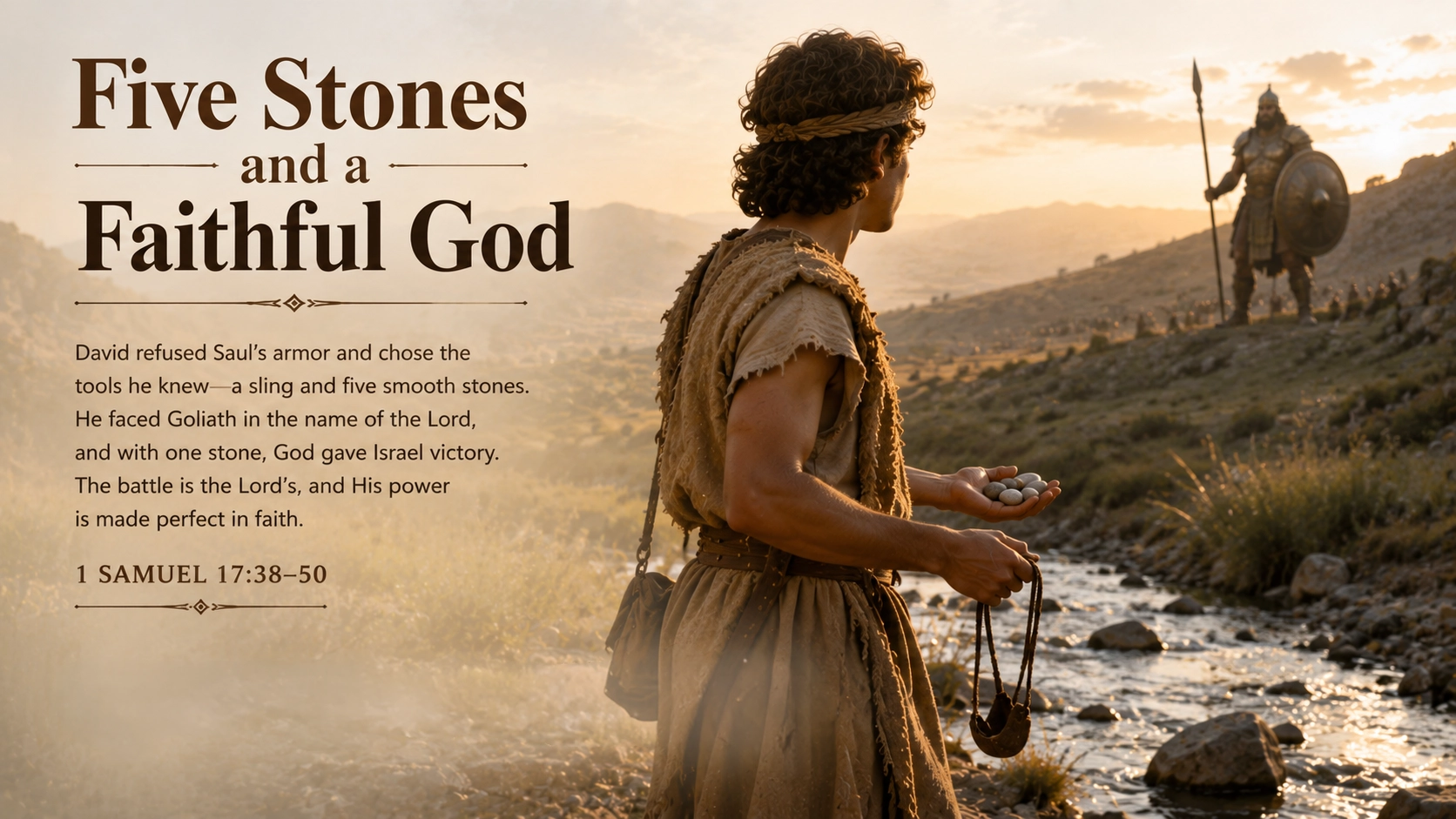
Saul offers David his armor before David faces Goliath, but the armor doesn’t fit and David cannot move comfortably in it. David removes it and chooses the tools he knows: his shepherd’s staff, sling, and five smooth stones. He confronts Goliath in the name of the Lord and defeats the giant with a single stone, showing Israel that deliverance belongs to God.
Devotional: Before David faces Goliath, Saul tries to make him look like a soldier. He places armor on David and gives him a sword. The equipment is valuable, proven, and meant for battle, but it doesn’t fit.
David can barely move. He removes the armor and returns to what he knows: a staff, a sling, and five stones gathered from a stream.
The difference between Saul’s armor and David’s sling is more than size. Saul tries to prepare David by turning him into someone else. David understands that he must face the challenge as the person God has already shaped him to be.
Comparison often convinces us that our own gifts are inadequate. We see someone else’s experience, resources, confidence, or influence and assume we must imitate them before we can serve God effectively. Their armor may be good, but it may not fit our calling.
David’s sling looks unimpressive beside Goliath’s weapons. Yet David has used it while protecting sheep. The ordinary days in the fields have prepared him in ways no one else can see. God has been shaping his courage and skill long before the public battle begins.
Our hidden seasons matter too. The patience learned while caring for a family member, the compassion formed through grief, the discipline developed in ordinary work, or the wisdom gained through failure may become part of how God uses us later.
David doesn’t trust the stone more than he trusts God. He declares that the battle belongs to the Lord. The sling is simply what he is prepared to use faithfully.
We should be careful not to turn this account into a promise that every giant will fall immediately. Some struggles continue, and some faithful people endure long battles. The central truth is that appearances don’t determine where God’s power is present. Goliath’s size and weapons don’t make him greater than the Lord.
Jesus won salvation through what the world viewed as weakness and defeat. The cross looked powerless, yet through it God overcame sin and death. God’s strength doesn’t always arrive wearing the armor we expect.
You don’t need to wear someone else’s armor. Bring God the person you are becoming, the experience you have, and the gifts He has developed in you. What looks ordinary may be exactly what you need for the next faithful act.
Five stones looked small beside a giant. In the hands of someone who trusted God, they were enough.
Action: Consider where comparison has made you doubt your gifts. Name one ability or experience God has developed in you and ask how it can be used faithfully.
Prayer: Faithful God, free me from the pressure to become someone else before I can serve You. Thank You for the ways You have shaped me through ordinary days, difficult experiences, and quiet acts of faithfulness. Help me recognize the gifts You have entrusted to me and use them with humility. When challenges appear larger than my strength, remind me that the battle belongs to You. Give me courage to stand in Your grace and take the step You place before me. In Jesus’ name I pray. Amen.
Thought for the Day: You don’t need someone else’s armor to use the gifts God has given you.
Saul’s armor was strong, valuable, and made for battle, but it didn’t fit David. Instead of trying to become someone else, David carried the tools he knew: a sling and five smooth stones. What looked inadequate became part of God’s deliverance.
First Samuel 17 reminds us that comparison can hide the gifts God has already developed within us. You may not have another person’s experience, resources, or style, but you don’t need their armor to obey God. Bring Him what you know, what you have learned, and who you are becoming. The battle still belongs to the Lord.